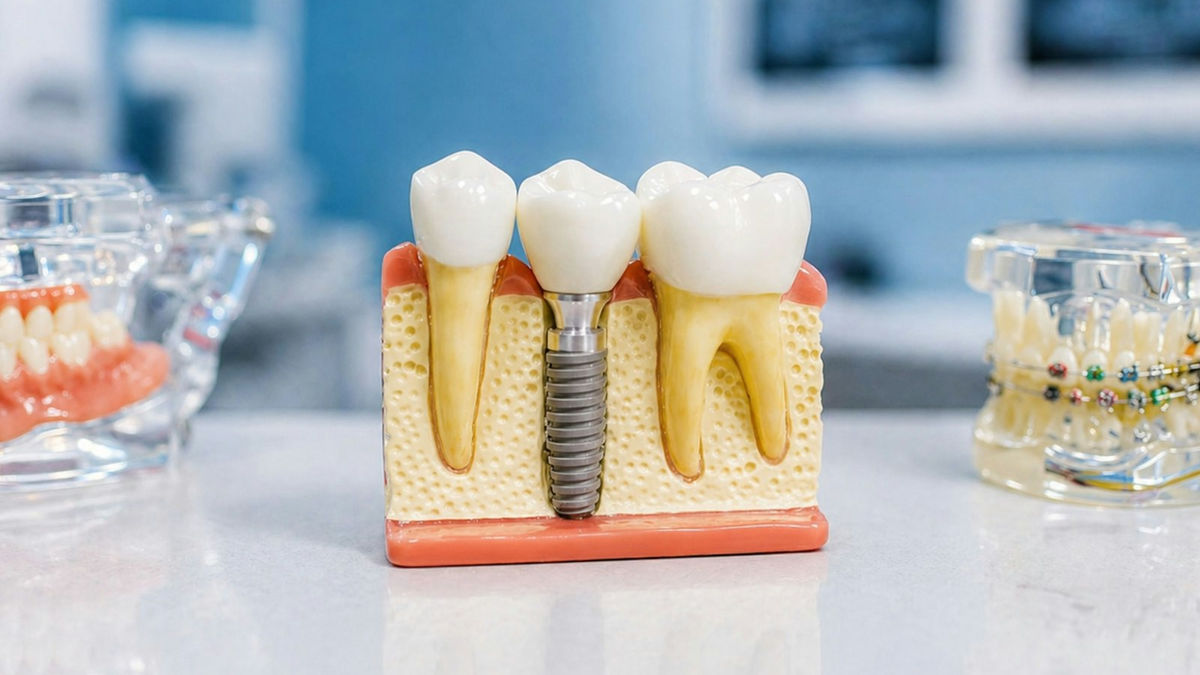


Short answer: The brand is a fair question in implant treatment, but on its own it is not decisive. The outcome is shaped by the condition of the bone and gums, the planning, how the surgical and prosthetic stages are carried out and the care that follows. When an implant system is assessed, criteria such as official registration, long-term scientific data, availability of parts years later and how well the system suits your mouth are considered.
Why is there no brand name in this article?
In Türkiye, consumer advertising of medical devices that only healthcare professionals can use is restricted by law, and dental implants belong to this group. That is why, instead of promoting or comparing particular brands, we explain the criteria worth asking about whichever system is used. You can ask your dentist about the manufacturer and system details of the implant recommended to you during your examination.
Before the brand: the foundation of treatment
The same implant system can give different results in different mouths, because the following factors determine whether treatment continues without problems over the long term:
- Bone quantity and quality: Whether there is enough bone where the implant will be placed, and whether bone grafting is needed.
- Planning: The angle, length and diameter of the implant and the position of the tooth that will sit on it. We cover this in our article on planning in implant treatment.
- Gum health and oral hygiene: Gum inflammation around the implant is among the problems commonly seen in the long term.
- General health and habits: Smoking, uncontrolled diabetes and teeth clenching can affect healing and the lifespan of the implant.
You can find more detail on who implants are suitable for in our article who is suitable for dental implants.
Criteria considered when assessing an implant system
1. Official registration and documents
Medical devices placed on the market in Türkiye must be registered in the Product Tracking System (ÜTS) of the Turkish Medicines and Medical Devices Agency (TİTCK). The CE marking, which shows conformity with European regulations, is also among the documents considered. The packaging of a registered product carries the manufacturer details, product code and batch (lot) number.
2. Scientific data and clinical follow-up
Independent scientific studies and clinical follow-up data showing how a system performs over many years are important. Systems that have been on the market for a long time and have published data make it easier for the dentist to anticipate how treatment may go.
3. Availability of parts years later
The implant body can remain in the bone for a long time; however, the screw, the connecting part (abutment) or the crown on top of it may need to be replaced over the years. Being able to obtain the system’s parts in the future therefore makes things easier if you move or continue treatment at a different clinic.
4. Connection type and system options
Implants are joined to the parts mounted on them through different connection types (e.g. a conical or internal hexagonal connection). A range of diameters and lengths gives planning more flexibility in situations such as narrow bone or limited space. We explain how the parts fit together in our article what are the parts of a dental implant.
5. Material and surface
Dental implants are mostly made of titanium or titanium alloys; in some cases zirconia implants may also be considered. Treatments applied to the implant surface can affect the process of fusing with the bone. Which material suits you is decided by assessing your bone condition and your expectations together.
6. Original and compatible restorative parts
Some manufacturers produce compatible connecting parts designed to be used with other systems. Which part will be used is decided jointly by the dentist and the dental laboratory, taking into account the implant system and the type of prosthesis. What matters is that every part used is registered and that its compatibility with the implant is verified.
Questions you can ask your dentist
- Which implant system do you recommend for me, and why are you considering this system?
- Can I get the product and batch details of the implant and of the parts that will go on it?
- Do I need bone grafting or an additional procedure?
- Will the tooth on top (the crown) be screw-retained or cemented?
- If parts need to be replaced in the future, what will the procedure be?
- How often will my check-up appointments be?
We explain why it helps to keep this information together in our article implant card and implant information.
Orthodontics and implants can be planned together
Where a tooth is missing, the neighbouring teeth may have tilted into the gap over time. In that case, straightening the teeth orthodontically before the implant can create more suitable space for it. For details, see our implants and orthodontics page. If you would like to compare the options for a missing tooth, our article implant or bridge can also help.
Frequently asked questions
Is a well-known brand always more suitable?
A brand or its recognition is not a criterion on its own. The system’s suitability for you, its official registration, its scientific data and the dentist’s experience with that system are assessed together.
How can I find out the brand of my implant later?
The patient records at the clinic where the treatment was done contain the product and batch details of the implant. If you cannot access this information, an X-ray and an oral examination can in some cases help to estimate the system; however, definite information comes from the records.
Can a new tooth be fitted on an implant placed at a different clinic?
In most cases this is possible; however, knowing the system and the connection type makes the process easier. That is why it is recommended that you keep your implant information.
Can an implant I had placed abroad be checked here?
Check-ups and maintenance can usually be carried out. If you have your treatment documents, X-rays and implant information with you, the assessment moves along more quickly.
How can you find out what suits you?
The information here is general; the right option for you is determined through an examination and the dentist’s assessment. For appointments and directions, see our contact page.