
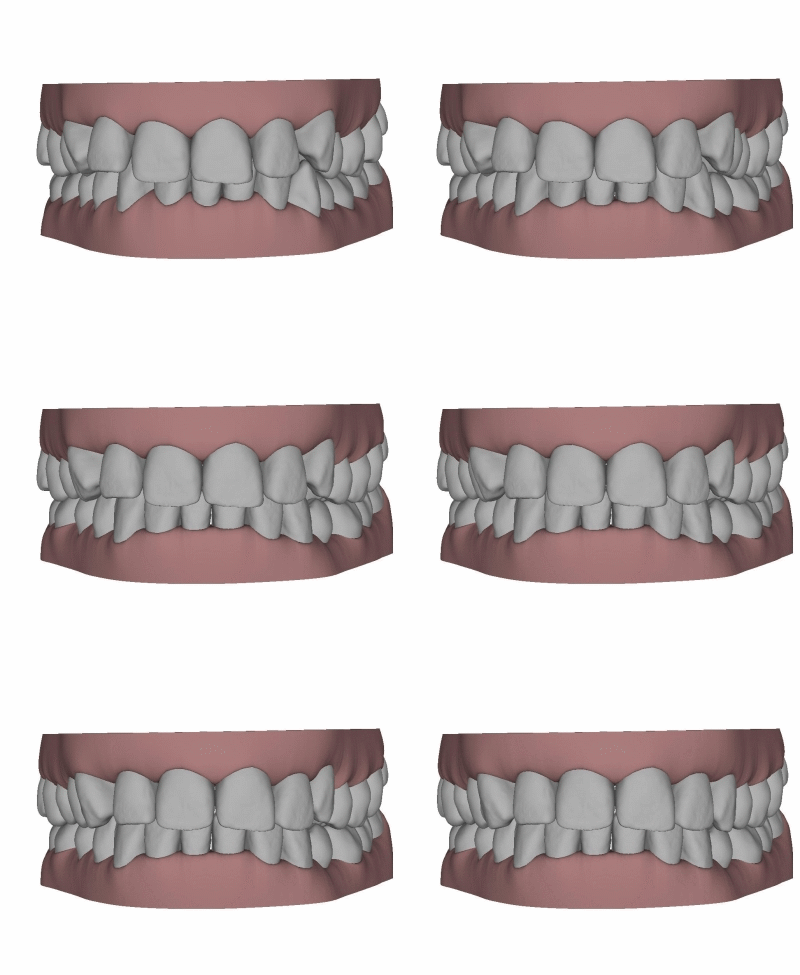
For a practical example, you can watch how crowded teeth are aligned aligner by aligner in the illustration at the top of this page.
Why does crowding happen?
- Mismatch between tooth and jaw size: The total width of the teeth is greater than the length of the dental arch
- Heredity: Jaw and tooth size can run in families
- Early loss of baby teeth: Neighbouring teeth drift into the gap and narrow the space for the permanent tooth
- Changes with age: Crowding can increase in adulthood too, especially in the lower front teeth
- Relapse after orthodontic treatment: Teeth shifting back when a retainer is not worn
Degree of crowding
| Degree | Approximate lack of space | Common approaches |
|---|---|---|
| Mild | Up to 3 mm | Clear aligners, limited IPR, slight arch expansion |
| Moderate | 4–6 mm | Clear aligners or brackets; expansion, IPR, tipping the front teeth forward |
| Severe | 7 mm or more | Comprehensive planning; extraction is sometimes needed |
These figures are a guide. The space needed is assessed together with the facial profile, lip support, gums and bone structure.
What problems can crowding cause?
- A higher risk of plaque build-up between the teeth, cavities and gum inflammation
- Uneven loading and wear on some teeth
- Concerns about self-confidence related to the appearance of the smile
How is space gained?
Arch expansion
In suitable cases, a narrow dental arch is widened in a controlled way. During growth, palatal expanders can also be used.
Interproximal reduction (IPR)
A very small amount of enamel is removed from the sides of the teeth, within safe limits. For details, see the orthodontic glossary.
Adjusting the position of the front teeth
Space can be gained by tipping the front teeth slightly forward; the amount is limited by the lips and gums.
Extraction
In severe crowding, and in some cases where the profile is also assessed, one or more teeth may need to be extracted. This decision is based on the records.
Treating crowding with clear aligners
Most cases of mild and moderate crowding can be treated with clear aligners. In the digital plan, each aligner is designed to move the teeth by a small amount; small attachments can be added to the teeth to control rotations. For details, see the clear aligner treatment process page.
After treatment
Once crowding has been corrected, the teeth – especially the lower front teeth – tend to move back. That is why long-term retention with a fixed wire or a night-time retainer is recommended.